
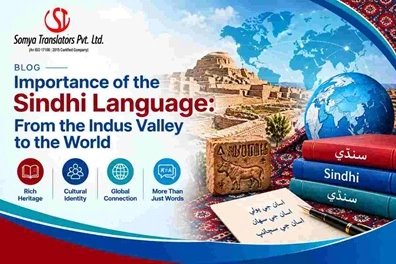
The importance of the Sindhi language goes far beyond its history. Sindhi takes its name from Sindhu, the ancient Sanskrit word for the Indus River. It grew up along one of the oldest river valleys in the world, and tens of millions of people still speak it today.
More than 34 million people speak Sindhi in Pakistan, and around 2.8 million speak it in India. Including diaspora communities in Oman, the UAE, Singapore, the UK and the US, the worldwide total is roughly 40 million. Sindhi is an official language in Pakistan’s Sindh province and a scheduled language of India.
In this guide, you will learn where the Sindhi language came from, which scripts it uses, what makes it unique, and why businesses need professional Sindhi translation.
Where Did the Sindhi Language Come From?
The Sindhi language developed in the Sindh region, in the north-western part of the Indian subcontinent. Most linguists trace its roots to Prakrit and Sanskrit, which places it in the Indo-Aryan language family.
Over the centuries, Sindh welcomed Greeks, Persians, Turks, Mughals and Portuguese traders. Each group left a mark on the vocabulary. As a result, Sindhi now carries words from Arabic, Persian and Dravidian languages.
Historians still debate the exact starting point of Sindhi. However, they agree that it kept its own grammar and identity despite these outside influences.
Which Script Does the Sindhi Language Use?
The script depends on the country:
- Pakistan: Perso-Arabic script
- India: Perso-Arabic and Devanagari scripts
This dual-script usage makes script selection a key step in any Sindhi translation project. Content for readers in Sindh, Pakistan needs Perso-Arabic. Content for many Indian Sindhi readers may need Devanagari.
Punjabi has a similar situation. You can read more in our guide on Punjabi translation services: Gurmukhi and Shahmukhi scripts.
Main Dialects of the Sindhi Language
Like most Indo-Aryan languages, Sindhi has several dialects. Six are commonly cited:
| Dialect | Where it is spoken |
|---|---|
| Vicholi | Central Sindh |
| Siraiki | Upper Sindh |
| Lari | Lower Sindh |
| Kacchi | Kutch region, Gujarat (India) |
| Thari (Thareli) | Thar desert and southern Sindh |
| Lasi | Lasbela region, Balochistan |
Vicholi is the standard and most widely used dialect. It appears in literature, education and administration across Sindh province.
What Makes the Sindhi Language Unique?
Sindhi stands apart from other Indo-Aryan languages in four ways:
- Complex sound system: The Perso-Arabic script uses 10 vowels and 42 consonants. The Devanagari script uses 10 vowels and 43 consonants. A small change in sound can change a word’s meaning completely.
- Vowel endings: Most Sindhi words end in a vowel sound, so the language is often described as musical.
- Flexible vocabulary: Its Sanskrit base lets Sindhi absorb foreign words without losing its grammatical structure.
- Two scripts, one language: Very few languages are written in two completely different scripts across two countries.
These features make Sindhi rich to speak and read. However, they also make it hard to translate without native-level expertise.
Literary Heritage of the Sindhi Language
Sindhi literature shows the cultural value of the language. It gained wide popularity over the last 300 years, but its roots go back much further. Key names include:
- Shah Abdul Latif Bhittai: One of the most celebrated Sindhi poets. His verse was compiled in Shah Jo Risalo and later translated into Urdu, English and other languages.
- Sachal Sarmast: A Sufi poet known for mystical verse and bold criticism of religious orthodoxy.
- Sami: A poet whose work leans toward spiritual and philosophical themes.
- Mirza Kaleech Beg: A major prose writer who widened Sindhi literature beyond poetry.
Together, these writers gave Sindhi a standard literary form. They also helped preserve the language across generations and borders.
Importance of the Sindhi Language in the Modern World
The Sindhi language matters today for four reasons:
- Official recognition in two countries: It is official in Sindh province and a scheduled language of India.
- A large speaker base: With over 34 million speakers in Pakistan, Sindhi is one of the country’s most spoken languages. India adds around 2.8 million more, mainly in Gujarat (especially Kutch), Rajasthan and Maharashtra.
- A global diaspora: Sindhi communities live across the Gulf, Southeast Asia, the UK, Canada and the US.
- Business relevance: Companies working in Sindh or Kutch, or serving Sindhi communities abroad, need content in the right language and script.
Why Businesses Need Sindhi Translation
Sindhi translation supports many sectors:
- Legal translation: Court filings, certificates and official notices.
- Government and public communication: Official information that Sindhi-speaking citizens can understand.
- Marketing and business content: Campaigns for companies entering Sindh or reaching Sindhi communities worldwide.
- Education and e-learning: Sindhi is used for educational content in Sindh province.
- Media and entertainment: Subtitling and dubbing for regional audiences.
Each sector has different needs. Legal documents need precision and often certified translation. Marketing content needs cultural fluency. Missing either can cost money, time and credibility.
Why Choose a Professional Sindhi Translation Company?
Because of its two scripts and six dialects, Sindhi is not a language where machine output is enough. A reliable provider of language translation services offers:
- Native Sindhi linguists who understand regional differences
- Correct script selection for the target audience
- Subject-matter expertise in legal, technical and medical content
- Multi-step quality review before delivery
- Consistent terminology across large projects
Also look for certification. ISO 17100:2015 is the international standard for translation service quality.
Frequently Asked Questions About the Sindhi Language
Where does the word “Sindhi” come from?
It comes from Sindhu, the ancient Sanskrit name for the Indus River.
How many people speak the Sindhi language?
Around 40 million people worldwide. About 34 million live in Pakistan and close to 2.8 million in India, and the rest are in diaspora communities.
What script is Sindhi written in?
Perso-Arabic in Pakistan. In India, both Perso-Arabic and Devanagari are used.
No. Sindhi uses an Arabic-based script, but its core grammar and vocabulary come from Prakrit and Sanskrit.
How many dialects does Sindhi have?
Six main dialects: Vicholi, Siraiki, Lari, Kacchi, Thari and Lasi.
Which Sindhi dialect is the standard?
Vicholi, spoken in central Sindh. It is used in literature, education and administration.
Who are the most famous Sindhi writers?
Shah Abdul Latif Bhittai, Sachal Sarmast, Sami and Mirza Kaleech Beg.
Why do businesses need professional Sindhi translation?
Two scripts and six dialects mean a wrong choice can confuse or alienate readers. Native experts make sure the right script and dialect are used.
How much does Sindhi translation cost?
The cost depends on content type, industry, word count and language pair. Get a free quote here.
Where can I find a reliable Sindhi translation company?
Somya Translators is an ISO 17100:2015-certified language service provider for legal, business, educational and media content.
Conclusion: Get Accurate Sindhi Translation
The Sindhi language links ancient history with modern business. Choosing the right script and dialect is what makes a translation work.
Somya Translators’ native Sindhi linguists handle dialect, script and certification needs with precision. Get a free quote today.
Call +91-9990094796 or email: info@somyatrans.com.
