Expanding into a new market is always a golden opportunity for business growth. Having to engage with new audiences, explore fresh revenue streams, and strengthen the global brand name—it all looks so promising. However, this promise comes with some risk when businesses translate their messages for a new market.
Many times, business message translation can become a failure. This could be due to several reasons: working with inexperienced translators, rushing translations, or not implementing proper quality control. As a translation company that regularly deals with business content translation, we have realized that quality control is one of the most vital elements in ensuring value-driven results.
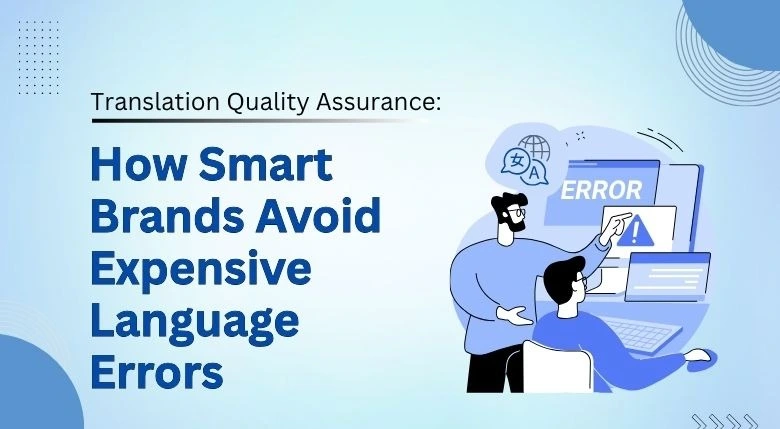
Inconsistent terminology, spelling mistakes, and cultural mismatches can all impact the quality of translation. Fortunately, all this can be easily avoided with proper translation quality assurance steps.
This blog will explore how professional linguistic quality assurance by translation services can help businesses expand efficiently across different markets.
What is Translation Quality Assurance?
Translation quality assurance is a vital step undertaken by professional language service providers that verifies whether a translated text meets the linguistic and cultural standards.
While businesses rely on professional translation services to maintain linguistic accuracy, well-defined QA steps guarantee cultural resonance and contextual precision.
A robust QA process ensures:
- The translated content is accurate and consistent.
- Terminology is used correctly.
- Grammar and syntax are error-free.
- Cultural references are properly adjusted.
In simple terms, QA ensures that your content resonates in the target region.
Why Does Quality Assurance Matter So Much?
Expanding into a new market is exciting, but it comes with several challenges. Without translation quality assurance, poor translations can occur, which can lead to misunderstandings and legal consequences.
But by prioritizing linguistic quality assurance (LQA), businesses ensure:
- Consistency in the Content: Chances are that consumers would trust your material if the language used in it is consistent. Professional linguistic quality assurance helps businesses use uniform terms and tone across their websites, documents, and marketing materials.
- Identify Errors Before They Cause Problems: For businesses, even the most insignificant error can look unprofessional and unappealing. By applying reliable translation, proofreading, and editing processes, businesses can ensure that their content is polished, error-free, and ready for the market.
- Drives Better Business Outcomes: Using quality translations, businesses can connect better with their diverse audiences, leading to more customers and generating revenues and profits.
Key Elements of a Strong QA Process
Today, professional translation services implement some invaluable quality assurance steps to ensure complete and precise translations. These steps include:
- Creating a Glossary: A glossary is a list of pre-approved, industry-specific terms along with their translations. An accurate glossary ensures that the translation is correct and consistent.
- Translation Memory: Advanced terminology management tools are databases that store previously translated words and segments. This speeds up translation, improves consistency, and reduces errors. Some examples of translation memory tools are SDL Trados, memoQ, and Lokalise.
- Style Guides: These define the tone, voice, and formatting rules expected by the client. A proper and well-defined style guide aligns the translation with the brand identity.
- LQA: This is a vital step where a language expert reviews the translated files for fluency, clarity, and accuracy.
- Cultural Review: Adapting the translated content to suit the local customs and respecting cultural sensitivity.
- Linguistic Testing (If Necessary): This is a process that involves testing the reviewed content with a small group of the target audience to check if it is appropriate and relevant to them.
- Back Translation (If Necessary): This is a process of translating the translated file back to the original language to check accuracy. This practice is generally implemented with content related to medicine or healthcare.
Along with this, a translation checklist is also a vital part of the process. Explore our related blog to learn more about the role of a translation checklist: Professional Translation Services: This is Why You Need a Checklist!
Do You Want to Ensure High Accuracy in Your Translated Documents?
Some Commonly Asked Questions
Q) Is it really necessary to ensure appropriate culture in translations?
Ans. Yes, it definitely is. Respecting the target culture in translations helps to establish trust between the business and the consumers.
Q) Can’t I review the translated file using AI?
Ans. High-quality translation QA services offer human expertise that follows this approach:
- Initial translation by a subject-matter expert.
- Review (both linguistic and cultural) by a second linguist.
- Final edit to refine the tone and clarity.
This multi-layered approach cannot be achieved by using AI.
Q) Where can I find a professional translation service that focuses on LQA?
Ans. A reliable partner that can handle your multilingual communication needs with high quality is Somya Translators. We are a leading language service provider with:
- Expert and native linguists.
- ISO 17100:2015-certified process.
- Multi-step approach to our quality assurance.
- Proper use of terminology glossaries, memory tools, and style guides.
- Special attention to client feedback to ensure every requirement is met.
- Global support in over 170 languages.
- Scalable services that include localization, MTPE, DTP, and interpretation.
If you are expanding your business in a new market and want to ensure clear, accurate, and high-quality translations, Somya Translators might just be the answer.
Contact us today to check out our expert translation services and get a free quote!
Call: +91-9990094796
Email: info@somyatrans.com